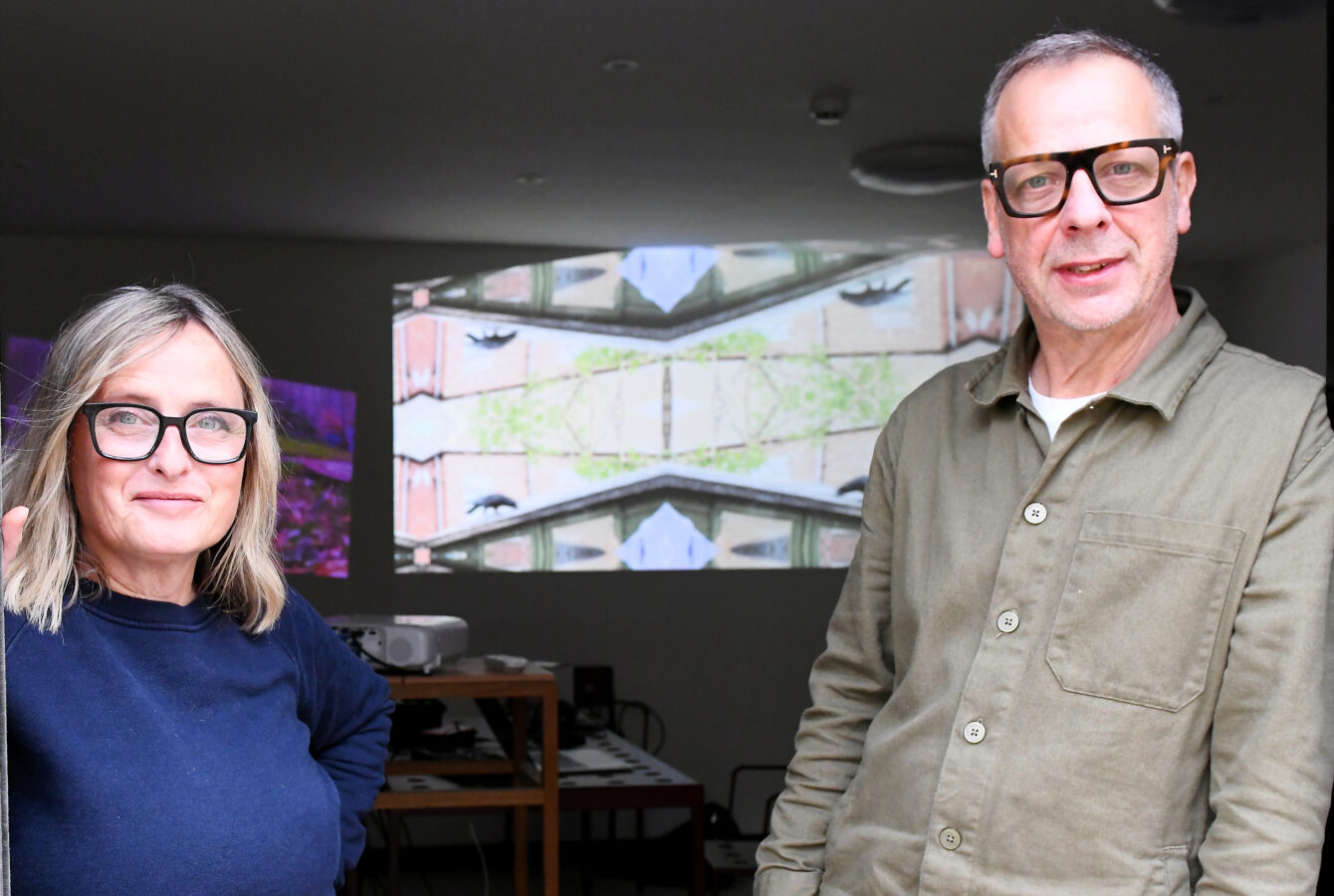

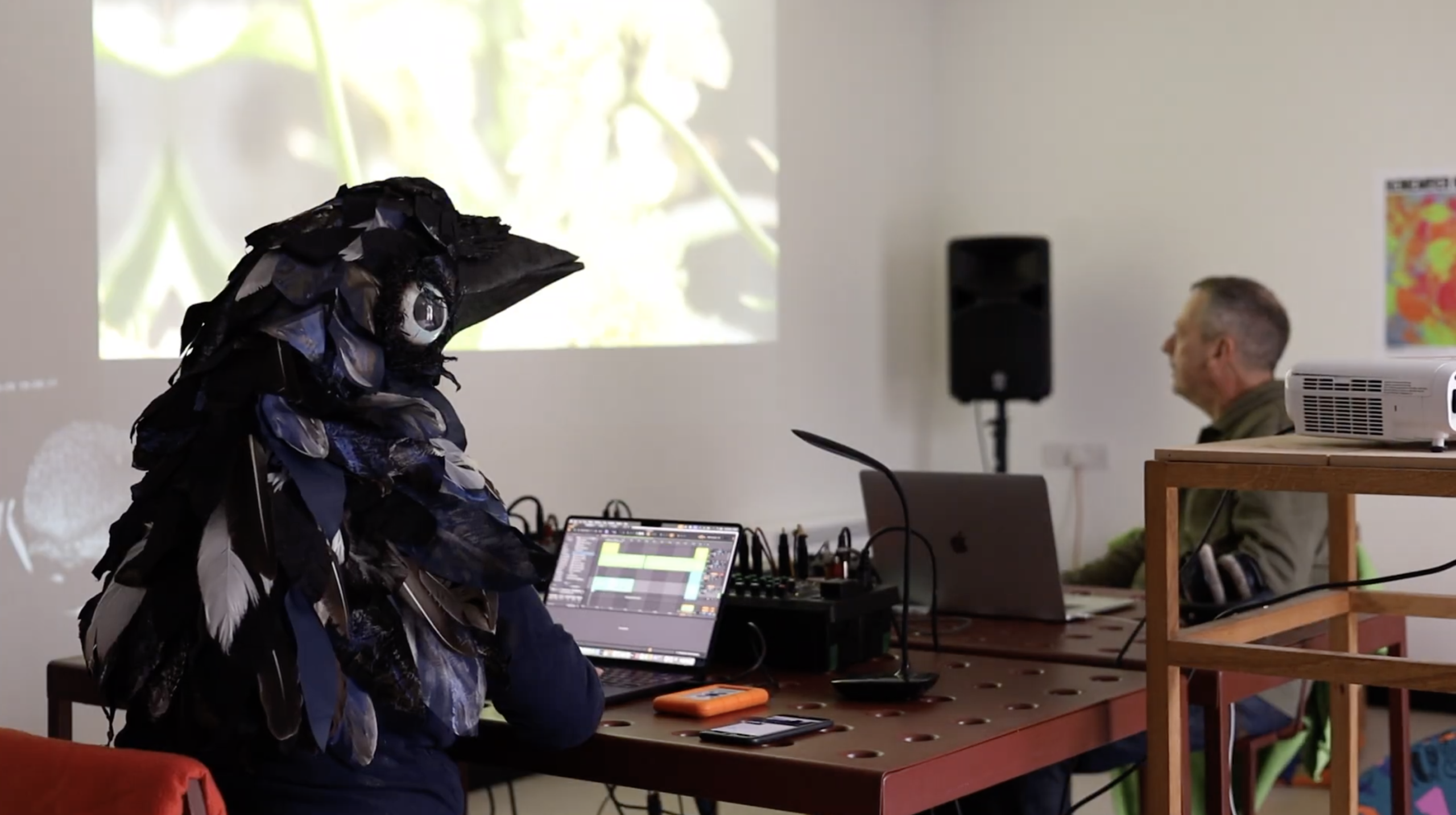
We caught up with A Man Called Adam’s Sally Rodgers and Steve Jones to talk about Birdy, an immersive audiovisual work created for the “Remember Nature” campaign.
Blending field recordings, kinetic visuals, and close observation, Birdy explores how birds live alongside us, adapting to human-shaped environments. Performed at Tate Modern and MIMA, the project invites audiences into a shifting soundscape where birds move from background to collaborators.
From suburban gardens to coastal skies, their work opens up a deeper way of listening, one that reveals the layered rhythms of human and non-human life, memory, and time.
Your work often invites what you call “deep listening.” In the context of birdsong, what does it mean to really listen, beyond identification or aesthetics, and how might that shift our relationship to the environments we inhabit?
Sally: If we ever do Deep Listening with groups we say ‘what’s the furthest sound you can hear/’ and ‘what’s the nearest?’ I live on a 1930s suburban housing estate and birdsong, or I think more accurately bird sound, reverberates around the houses and into the spaces and makes a kind of 3D mind map of the place. We’re all wired differently so there are layers of emotional response to sound that are unique to everyone and I guess for me, those sounds are a map of home, they give me peace. I’ve tried to make my little garden welcoming for birds and insects. We have such an incredible variety of birds here on the coast – seabirds/ songbirds/ corvids. There are wetlands in Teesside so sometimes we’ll see a heron or hear great flocks of migrating geese. We hear them chattering, squabbling, nest building, staking territories or letting out warnings. And I really love the differing sounds of their flight – fat pigeons sound very different flapping about to a flock of jittery starlings taking off. And all this happens alongside the sounds of a neighbour pressure washing their drive, or kids playing in the street. Sound is how Steve and I interact with the world but I think if we truly listen we become aware and more appreciative of the complexity and wonder of sharing our environment with non-human species. We live together and we should do all we can to be good neighbours.
We do love the Merlin identification app btw, especially if we’re away from our neighbourhoods. Such a brilliant bit of tech innovation.
Over time, birds in Birdy seem to move from sampled material to something closer to co-authors. At what point does a field recording stop being a source and start becoming a relationship?
Sally: With surveillance cameras and hidden mics we effectively spied on the bird and wildlife in this suburban environment to create Birdy. All those sounds and sights turned them into collaborators. They are the stars of the show, we just listened and looked at them very deeply, just going about their business. Our aim was always to highlight that world beyond your own.
This month’s theme frames birdsong as a form of territory-making. Do you hear your performances as entering that territory, borrowing it, or creating a parallel sonic space alongside it?
Sally: I think that’s why sound is so wonderful and compelling. It is both physical and time bound – plastic (as Xennakis would say) – and yet our responses are so idiosyncratic. Me and Steve have an innate communication when we’re working with sound together. We improvise to create new sonic worlds that are an expression of the source through the kaleidoscope of our own creative lives.
Improvisation usually implies responsiveness between human performers. How does that change when one of your “partners” is non-human, unpredictable, and not performing for you?
Sally: There are no mistakes in sound. Birds can’t be controlled so we’d never try. It’s a waiting game really. Respectful. To paraphrase John Cage you have to let ’sounds be themselves’.
Steve: That’s the excitement of improvisation: starting with nothing, not knowing where it might go, following the gestural quality of the birds’ voices as patterns and phrases emerge.
Do you see your role as translating birdsong into a human musical language, or amplifying it so we can better perceive what’s already there?
Sally: We keep it abstract. We express ourselves and they express themselves. I think yes, it is a way of amplifying and translating the wonder that’s inherent in the detail of their sonic communications.
Steve: It’s not only birdsong, we look at the everyday sounds birds make in their environment: the rhythms of hopping across a shed roof, interactions with each other, feeding, drinking and cleaning. By treating the microphone as a microscope (after Westerkamp), it means we can examine these sounds, to interact and play with them.
Projects like Birdy sit in spaces shaped by human intervention, gardens, pavilions, cities. How have you noticed birds adapting sonically to these environments, and has that changed how you compose or perform?
Sally: I’m obsessed with the crows that live near me. I don’t think they’ve adapted sonically, they just look for habitat, food, places to nest, places they can defend. They battle with the gulls, the magpies. I have bird food in the boot of my car and they shout ‘bird food lady is out!’ when I appear. They know my dog’s bark. It’s the ordinary, the minutiae of their lives where the magic can be found and that’s true of people too.
A five-hour work resists the tempo of most contemporary culture. What does duration allow in terms of listening, especially in relation to seasonal or ecological time?
Sally: like the bird sounds map the space they also register time. Evening sounds are very different to morning. It’s a sonic ecology that’s affected by the movement of the planets, the seasons, the weather – just like human activity. Birds disappear and reappear in primal rhythms. Slowing down, or sometimes compressing. Duration and ordered sound that maps time, that’s what music is, no? And it goes all the way back, it’s in our DNA – seasonal change, cycles of life.
Remember Nature draws from Metzger’s provocation. How do you interpret his call today, particularly in sound, and do you think birdsong offers a form of resistance, mourning, or even hope?
Sally: We interpreted Metzger’s ideas to Remember Nature as a prompt. Look and listen deeply and you’ll see how it’s possible for anyone, even with tiny green spaces, balconies, flower pots to play a part and to contribute to bio-diversity. To welcome birds you need to foster an ecosystem, insect life, mammals, make a space they feel safe. And they will reward you with their presence and their wonderful sounds.
Steve: Drawing on Metzger, we attempted an art action with no fixed expectations, focusing on allowing the process itself to unfold.
Birdsong is often framed scientifically (mating calls, warnings), but your work seems to leave room for something more, joy, play, excess. Is that projection, or something you genuinely perceive in the sound?
Sally: We always try to keep our practice playful, joyful, optimistic. These are serious times and I feel great pangs of sadness sometimes, when trees are felled for development for example. But there are so many people working tirelessly in defence of, and for Nature that there is cause for optimism. Being immersed in Nature is widely accepted now as something beneficial for our mental health. We’ve just come back from Castle Eden Nature reserve in Durham – an ancient native woodland – and the variety of birdsong was both thrilling and calming. Letting people hear that in focussed, playful, meditative or novel ways – that’s our job and we take it very seriously 🙂
Steve: It’s not just about scientific observation, but about sound as a way of being in the world. Encouraging nature into a small urban space can be a joyful act, one that pushes back against the helplessness we often feel in relation to climate change.
With younger audiences and groups like those involved at Tate Modern events, what kinds of listening habits do you hope people carry forward? Can listening itself be a form of ecological inheritance?
Sally: We’ve been so intimately involved with sound for so many years that it’s second nature for us to ‘hear’ the world as sonic landscapes. I never listen to music or wear earbuds or whatever when I’m out in the world for example. And it doesn’t have to be the sound of pristine wilderness. Even in the woodland today with dozens of different birdsongs and sounds enveloping us we could hear the distant sound of a freight train or a bandsaw. Our aim is only to turn on the switch to the wonder of sonority.